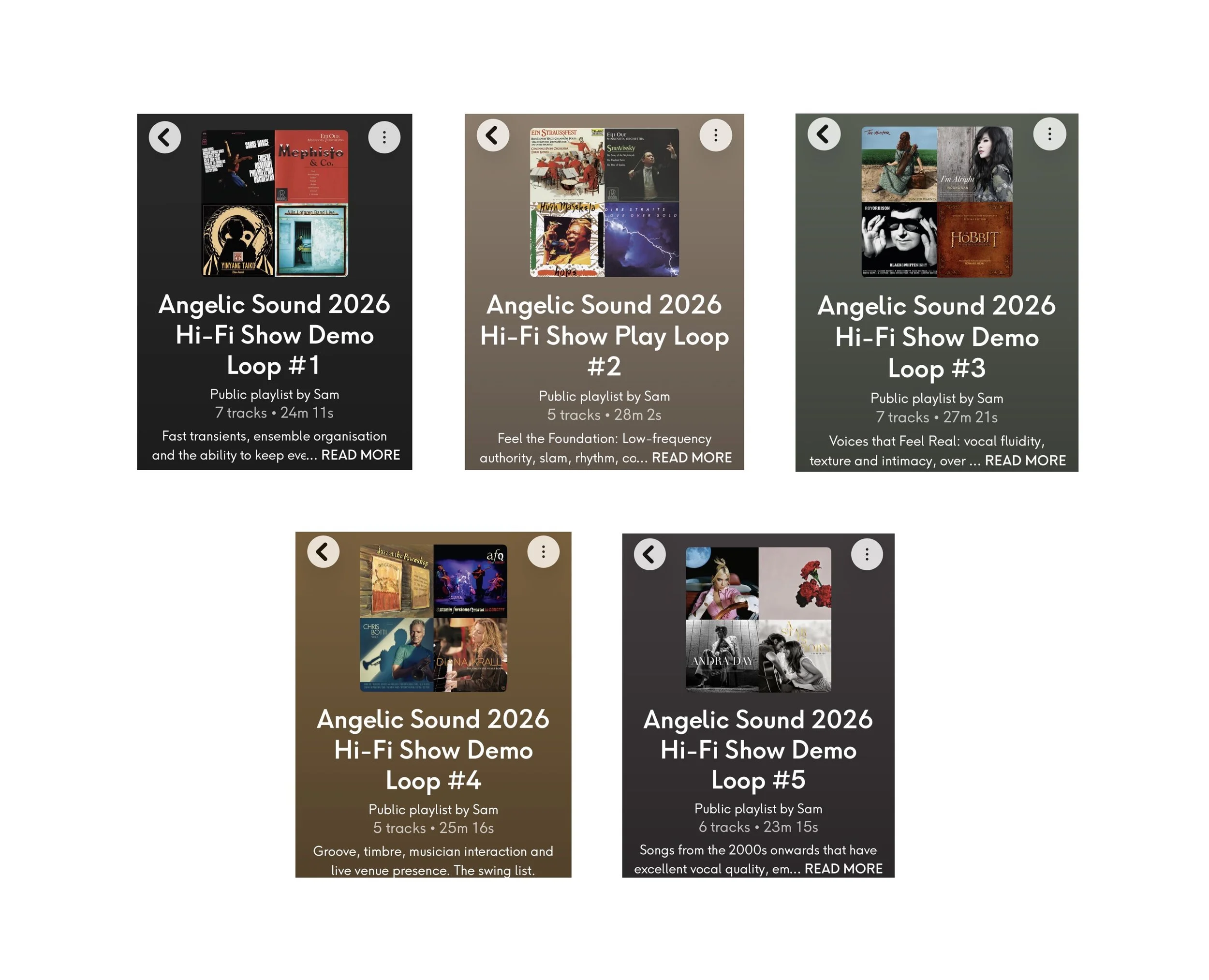
The 2026 Hi-Fi Show Demo List: Good Music & Good Hi-Fi
What is the purpose of Hi-Fi equipment? I often ask myself this when a technical discussion gets too deep and we start debating small differences between systems. Measurements and specifications matter, but I believe we sometimes forget the most important thing. We are here because we love music.
I love immersive music, whenever I go to a live performance, I wish I could bring that experience home with me. With the right recording and the right equipment, I believe this is possible. I enjoy hearing the character of a voice, the sound of an instrument, the atmosphere of a live performance, and the work that goes into capturing it well. I also enjoy recordings that challenge a system and help us understand what it can do.
I also believe we should keep an open mind about music. We all have our preferences, but I have made some wonderful discoveries by listening to music chosen by other people, including my children’s Spotify playlists.
This is one of the reasons I created Angelic Sound. I want to connect more people with music they may love, and help them discover what a good hi-fi system can reveal in a recording. It is not just about hearing more detail or having deeper bass. It is about hearing the performers more clearly, feeling the space in which they play, and experiencing the emotion that makes a performance real and special.
Over the past few weeks, I have been choosing tracks for the four demo loops I will play in Room 1313 at the 2026 Melbourne Hi-Fi Show. I have picked music that I enjoy, along with recordings that reveal different aspects of a system.
When you visit Room 1313, here are a few things you might notice:
· Soundstage: can you hear beyond the speakers, and sense the width, depth and space around the performers?
· Bass: does it have weight, pitch and timing, supporting the music without becoming muddy?
· Vocals: can you hear the body and breath of a real voice, without it sounding hard or artificial?
· Transients and detail: listen for the attack of a plucked string, the bow on a violin, or the impact of percussion, followed by the natural decay.
· Dynamics: can the system move from a quiet passage to a powerful climax without sounding strained?
· Emotion: most importantly, does the music make you feel something, rather than simply notice more detail?
The five loops each have their own character. The notes below each track are only suggestions. There is no right or wrong way to listen. I hope they help you discover something new and perhaps hear a familiar track in a different way.
#1 Attack and Decay
Qobuz: https://open.qobuz.com/playlist/71544618
Spotify: https://open.spotify.com/playlist/6rMHtEmxVM5zcztUFTca1f?si=d124b7b364454698
1. J. Strauss II , Chit-Chat Fast Polka, Op. 214. 2:45
Fast transients, ensemble organisation and the ability to keep every section clean when the music becomes complex.
2. Zhang Hao / YinYang Taiko , City of Kyoto. 1:45
Percussion attack, skin tone and physical impact.
3. Ricardo Gallén , La Catedral: III. Allegro Solemne. 3:10
Plucked-string attack, bass-string authority and the separation between notes at speed.
4. J. S. Bach , Violin Partita No. 3, BWV 1006: Preludio , Hilary Hahn 3:34
Bow control, micro-dynamics, string texture and the natural resonance of the violin.
5. Nils Lofgren Band , Bass & Drum Intro 3:29
A revealing transient test: hear the kick drum and bass guitar as distinct voices, with pitch and timing intact.
6. Mephisto & Co , Danse Macabre 6:50
Orchestral colour and dynamic contrast. Proves the detail still assembles into music at full scale.
7. Khachaturian , Sabre Dance (Gayane) , Ormandy / Philadelphia. 2:38
Xylophone struck hard and fast, snare and brass stabs. The single best transient test in the orchestral repertoire, and a short adrenaline exit after the Danse Macabre.
#2 Feel the Foundation
Qobuz: https://open.qobuz.com/playlist/71588149
Soptify: https://open.spotify.com/playlist/59OkOugTsoKlZXY8tjrz9y?si=b35a71370b2a4728
1. Hugh Masekela , Stimela (The Coal Train). 10:01
Bass weight, percussion impact, crowd energy and physical scale without losing timing.
2. Dire Straits , Private Investigations 6:45
Low-level ambience, texture, sudden dynamic changes and precise placement of percussion and guitar.
3. Stravinsky , The Firebird: Infernal Dance of King Kashchei. 4:59
Orchestral scale, explosive dynamics and depth layering. Use this movement on its own rather than playing the full suite.
4. Hans Zimmer , Underground Army (The Dark Knight Rises). 3:11
Deep cinematic pressure, sub-bass extension and control when the system is pushed.
5. John Fogerty , River Is Waiting. 3:22
Rhythmic authority, vocal body and the balance between bass energy and musical flow.
6. J. Strauss I , Radetzky March, Op. 228 , Cincinnati Pops / Kunzel. 3:03
Bass drum weight and the Telarc dynamic range, with brass and percussion snapping cleanly. A lively, feel-good finish.
#3 Voices That Feel Real
Qobuz: https://open.qobuz.com/playlist/71588212
Spotify: https://open.spotify.com/playlist/6GgTr9S28W1mHup10b5y9A?si=876e5cd680d74a48
1. Geoff Castellucci , The Sound of Silence. 4:34
Deep vocal foundation, chest resonance and control at the bottom end , weight without boom.
2. Misty Mountains , Richard Armitage & the Dwarf Cast. 1:42
Unaccompanied low male voices in a large reverberant space. Follows Castellucci deliberately: two deep male voices back to back, both testing chest weight without boom.
3. Jennifer Warnes , Way Down Deep 5:42
Low vocal weight, warmth and articulation, staying fluid rather than thick.
4. Dominique Fils-Aimé , Feeling Good 3:11
Vocal texture, dynamic expression and the relationship between the singer and the backing musicians.
5. Woong San, I Can’t Stand the Rain 5:37
Smoky vocal colour, rhythmic flow, bass definition and treble smoothness.
6. Rebecca Pidgeon, Spanish Harlem. 3:36
Natural vocal image, room ambience and the relationship between near and distant sounds. A key soundstage track: listen for the singer’s position and the space around the performance.
7. Roy Orbison , Only the Lonely. 2:59
Emotional intensity and vocal focus, carrying character without harshness.
#4 Live and Jazz
Qobuz: https://open.qobuz.com/playlist/71545790
Spotify: https://open.spotify.com/playlist/3BmscvXYjV5xYPssY6tsS7?si=6504804e908a4031
1. Antonio Forcione , Heart Beat (Live). 6:04
Live presence, transient attack, guitar body, percussion energy and musicians physically in the room.
2. Chris Botti , Danny Boy. 2:49
Trumpet tone, breath, brass texture and the precise placement of the soloist.
3. Diana Krall , Stop This World. 3:59
Female vocal body, piano tone, bass foundation and the intimate scale of the trio.
4. Arne Domnérus , Struttin’ With Some Barbecue. 6:40
Live club acoustic with an audience present. Alto sax and vibraphone, and the sense of a real room behind the band. Lifts the energy before the closer.
5. Patricia Barber – Regular Pleasures 5:44
A relaxed but tightly interlocking groove: separate the voice and piano from bass, guitar, drums and trumpet; keep it clear and unforced.
#5 Contemporary Voices
Qobuz: https://open.qobuz.com/playlist/71656326
Spotify: https://open.spotify.com/playlist/1CkqpggfYKJP0s4QcUANCM?si=99ac327b723e496b
1. Dua Lipa — Don’t Start Now 3:03
Punchy, articulate bass and tight kick/snare. Listen for groove and separation without low-end smear.
2. John Legend — All of Me 4:29
Piano weight and decay beneath a centred, intimate male vocal; hear breath and natural phrasing.
3. Andra Day — Rise Up 4:13
Vocal texture and the climb from restraint to full dynamic power without edge or compression.
4. Brono Mars & Lady Gaga - Die with a Smile 4:11
Listen for the contrast and blend between the two voices, with natural vocal texture, precise harmonies and a convincing central image.
5. A Great Big World - Say Something 3:49Listen for the intimacy of the piano and vocals, with delicate phrasing, natural decay and a sense of space around the performers.
6. Lady Gaga — Always Remember Us This Way 3:30
Vocal body and emotional build; the lead should stay fluid and present as accompaniment grows.
A final thought
I have chosen these tracks because I enjoy them and because they each have something to show us. You do not need to know the music or listen for every detail. If a song catches your attention, brings back a memory, or makes you want to hear it again, that is what matters.
For me, that is what good music and a good hi-fi system are all about.