
POW, POW, POW!
The Cen.Grand GLD1.0 Deluxe Media Player was engineered with a single, uncompromising objective: to deliver the highest‑integrity, highest‑bit‑rate digital audio transmission possible. With modern high‑resolution formats reaching DSD1024, any next‑generation digital source must move data with absolute precision and without compromise.
Despite the abundance of digital interfaces in consumer audio, very few can technically meet these demands.
Why Traditional Digital Protocols Fall Short
1. AES3 and S/PDIF: Bandwidth Bottlenecks
AES3 and S/PDIF were ruled out immediately. Their maximum throughput - 24‑bit/192 kHz PCM or DSD64 via DoP - is far below what today’s ultra‑high‑resolution formats require. These standards were never designed for the modern high‑bit‑rate landscape.
2. USB and I²S‑over‑HDMI: Capable on Paper, Compromised in Practice
This leaves two protocols theoretically capable of carrying high‑bit‑rate audio: USB and I²S‑over‑HDMI.
USB, while fast, introduces issues such as packet‑based transmission, host‑dependent timing, and electrical noise - topics covered in our earlier blog here.
I²S‑over‑HDMI, popularised by brands like PS Audio, is often promoted as a cleaner alternative. In reality, it carries several fundamental limitations:
a. No Standardisation
There is no universal I²S‑over‑HDMI pinout. Each manufacturer uses its own mapping, making cross‑brand compatibility unreliable.
b. Designed for PCB‑Level Communication
I²S was created for chip‑to‑chip communication over 1–2 inches on a circuit board. Extending it externally through an HDMI cable pushes the protocol far beyond its intended electrical environment.
c. Susceptibility to Signal Skew
Longer HDMI cables introduce timing skew between clock and data lines, degrading signal integrity.
d. No Error Correction
I²S is a one‑way, real‑time streaming protocol with no error correction or retransmission. If a bit is corrupted, the DAC cannot request a resend - it simply converts the flawed data.
This is arguably the most serious technical limitation.
PoW: Designed for Absolute Performance
To overcome these constraints, Cen.Grand developed POW (Parting-of-the-Ways) - a proprietary transmission protocol engineered specifically for high‑bit‑rate, high‑fidelity digital audio.
PoW separates the two most critical elements of digital audio transmission:
a. Data via Optical Fibre
Immune to electrical noise
Capable of gigabit‑level bandwidth
Zero ground‑loop risk
b. Clock via Coaxial BNC
Dedicated, stable, low‑jitter clock path
Robust impedance control
Industry‑proven connector standard
At the DAC, POW recombines the optical data stream and BNC clock into a clean, precise I²S signal for conversion.
This architecture preserves both data integrity and clock integrity, avoiding the compromises inherent in USB or external I²S.
Flexibility Without Compromise
While POW is the GLD1.0’s new preferred connection method, Cen.Grand recognises that users have diverse systems and upgrade paths.
The GLD1.0 therefore also includes USB, I²S‑over‑HDMI, AES3, S/PDIF (Coaxial & TOSLINK) and BNC connection sockets.
This ensures broad compatibility while offering a clear upgrade path to POW for those seeking the highest possible performance.
A New Benchmark in Digital Playback
POW is not just another connection option - it is a next‑generation transmission standard built for the era of ultra‑high‑bit‑rate music.
Combined with innovations such as the GLD1.0’s PCIe‑based internal communication architecture, POW helps establish the GLD1.0 Deluxe Media Player as a new reference point for lossless, high‑resolution digital audio.
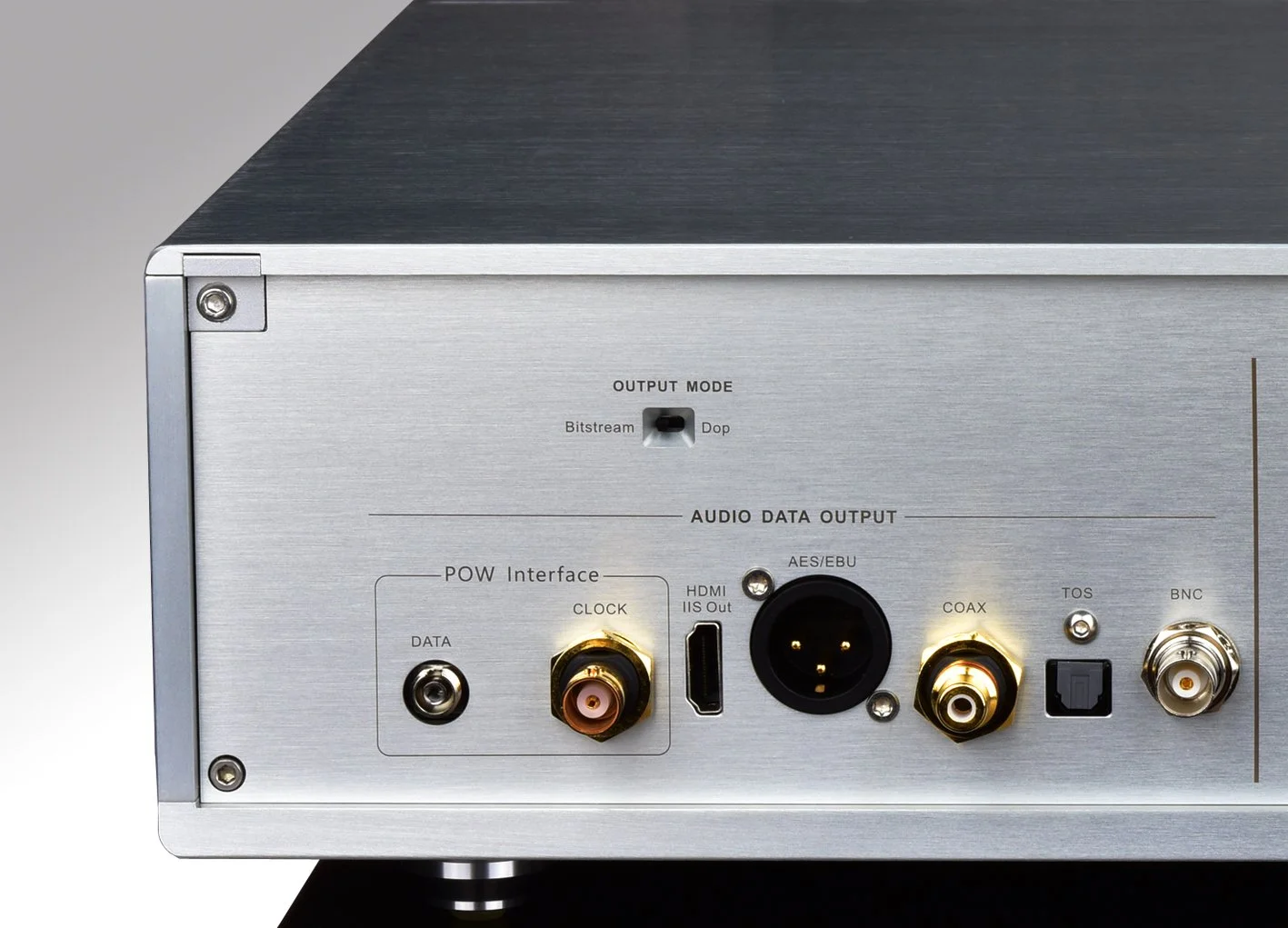
GLD1.0 Deluxe Audio Output sockets including POW, I2S-HDMI, AES/EBU, COAX, TOS and BNC.
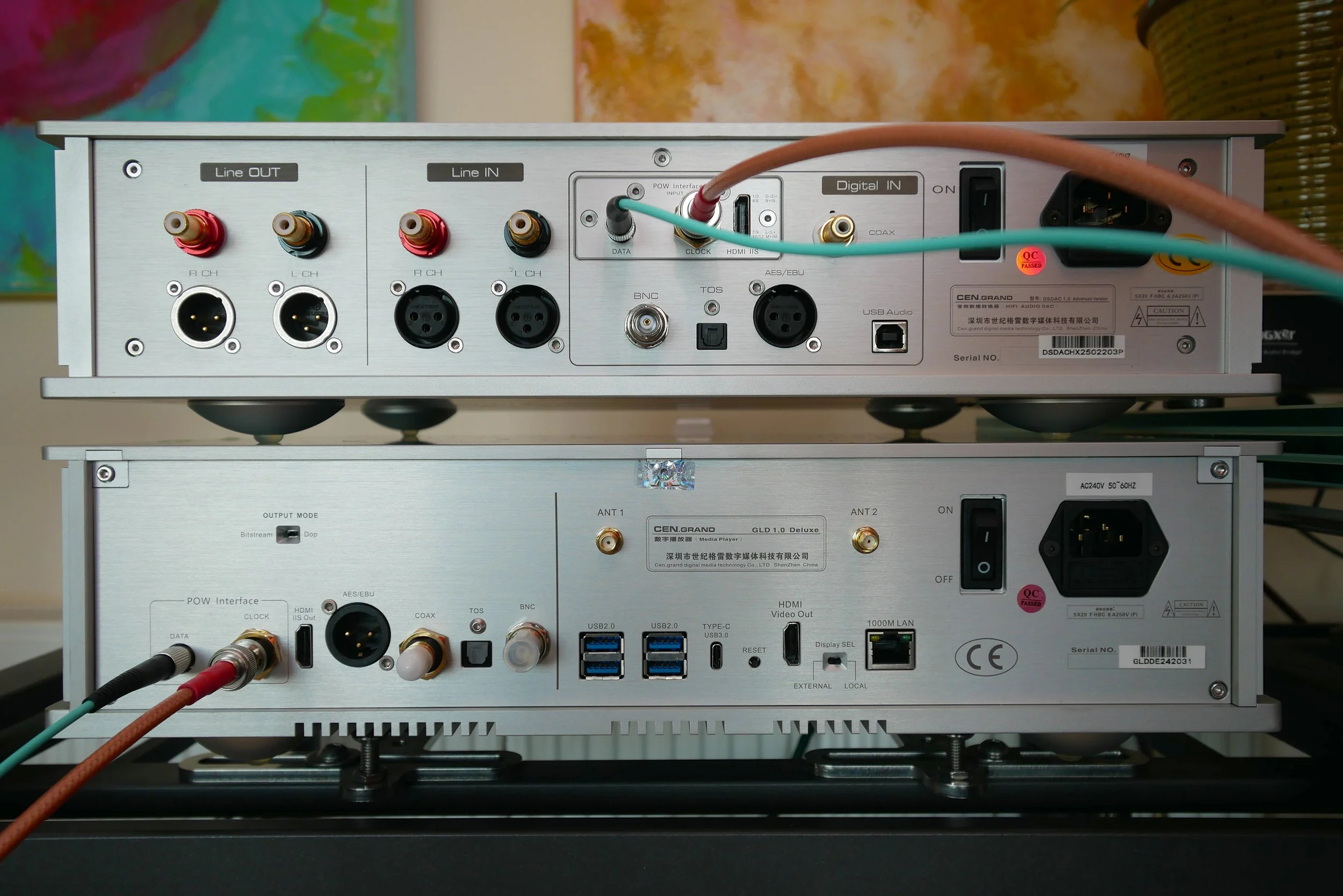
Cen.Grand DSDAC1.0 Deluxe DAC (top) and GLD1.0 Deluxe Media Player (bottom), connected via PoW
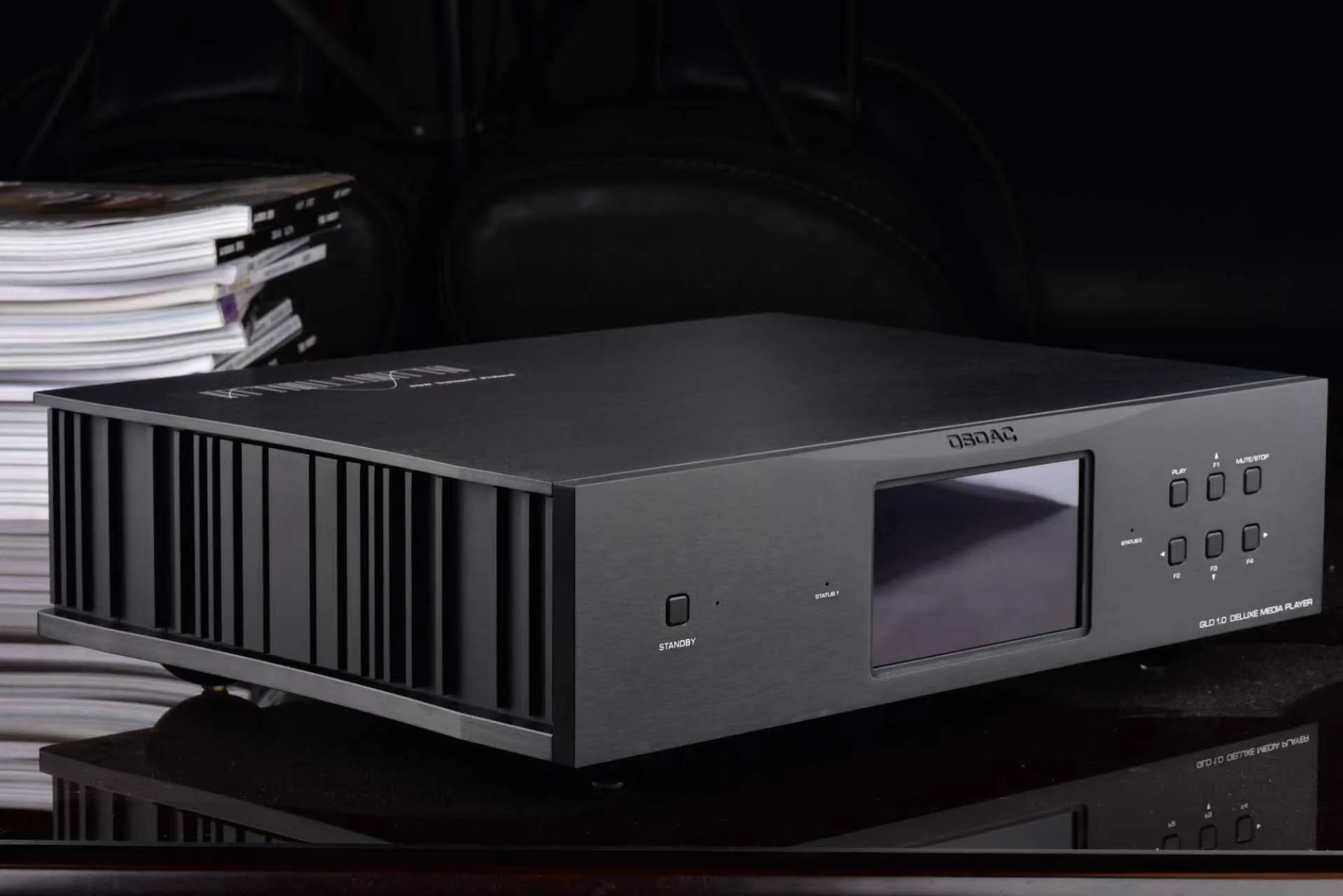
Cen.Grand GLD1.0 Deluxe Media Player
